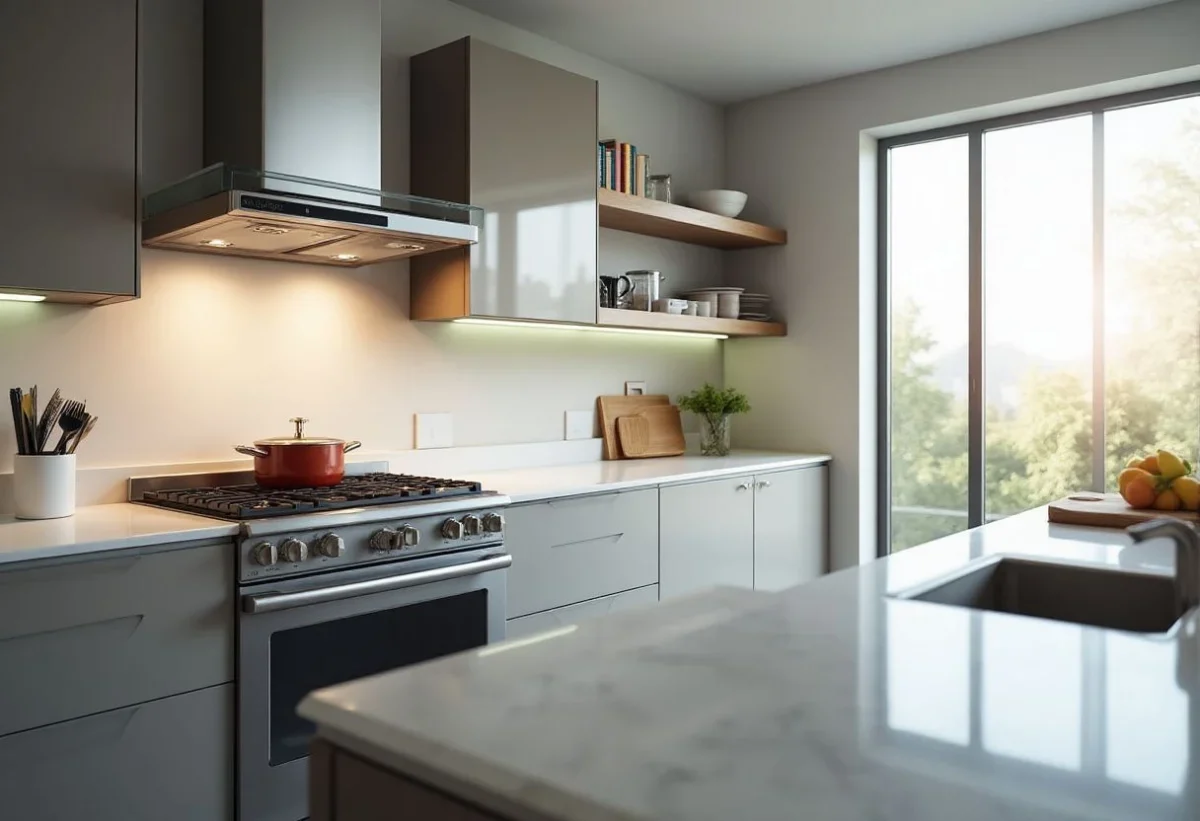
In our relentless quest for a streamlined and functional kitchen, a new trend is emerging, redefining the modern culinary space: the motorless hood. Unlike its traditional counterparts, this architectural innovation focuses on subtle aesthetics and discreet functionality. It appeals to bold design enthusiasts and discerning cooks eager to blend efficiency with simplicity. This kitchen element, devoid of an integrated motor, requires careful consideration regarding its installation and operation. Technical considerations, aesthetic choices, and practical implications intertwine to shape a space that is both beautiful and functional.
Understanding the concept of the motorless hood
Before diving into the technical and aesthetic details, it is essential to grasp what distinguishes the motorless hood from its conventional counterparts. This concept is based on the idea of separating the basic elements of cooking vapor extraction.
- The hood itself does not integrate a motor. This allows for a more flexible and often quieter installation, as the motor can be placed remotely.
- This configuration offers greater freedom in designing the space, as it does not require compromising on appearance to accommodate the integrated motor.
- By opting for a motorless hood, it becomes possible to choose more powerful and customized motors, which is ideal for kitchens where cooking is frequent and intense.
Advantages and disadvantages of a motorless hood
Adopting a motorless hood has many advantages, but it is not without a few drawbacks. Let’s analyze these aspects to help you make an informed choice.
Advantages:
- Acoustic flexibility: With the motor being distant, the noise level can be significantly reduced in the kitchen.
- Customized design: Without an integrated motor, the choice of materials and finishes is broader, allowing for a harmonious design with the rest of the kitchen.
- Adjustable performance: You can select a powerful motor if necessary, thus increasing the efficiency of the extraction.
Disadvantages:
- Complex installation: The positioning of the remote motor requires careful planning and often professional expertise.
- Initial cost: Investing in a motorless hood and a separate motor can be more expensive than all-in-one solutions.
- Maintenance: The separation of components can make maintenance more complicated, potentially requiring the intervention of specialized technicians.
Installation and maintenance: what you need to know
The installation of a motorless hood requires a methodical approach and particular attention to technical details. Here’s what to consider for a successful setup and optimal maintenance.
The installation begins with the strategic choice of the motor’s location. It should be far enough away to reduce noise disturbances while being close enough to ensure effective extraction power.
Next, the connection between the hood and the motor is made through ducts that must be perfectly sealed to avoid any loss of efficiency. The materials used for these ducts are also crucial, as they must withstand heat and humidity without degrading performance.
For maintenance, it is recommended to regularly clean the hood filters and check the condition of the ducts. Special attention should be paid to the motor, which should be dusted and lubricated periodically to prevent premature wear. In case of failure, calling a professional to diagnose and resolve issues is often the best solution.