
Lac d’Aiguebelette is home to the first regional natural freshwater reserve created in metropolitan France. This distinction, obtained in March 2015, is based on an ornithological heritage that the 2023-2032 management plan protects through a system of temporal and spatial zoning. Understanding this framework allows one to gauge what a birdwatching outing along the shores of the lake can truly offer throughout the seasons.
Zoning of the Aiguebelette Reserve: tranquility areas and accessible beaches
Most tourist content presents the lake as a swimming location bordered by natural spaces. The management plan adopted in 2023 introduces a more nuanced logic: a zoning that separates allowed beaches and areas of complete tranquility in spring. This distinction directly influences the organization of birdwatching outings.
During the nesting period, certain shoreline and reedbed areas are closed to pedestrian traffic. Guided outings then follow defined routes to limit disturbance to nesting birds.
Outside of spring, access to the shores is more flexible, and winter observation of waterfowl occurs from open points without particular restrictions. Therefore, planning a birdwatching outing at Aiguebelette beach requires checking the tranquility calendar in advance, or one may find inaccessible areas.
| Season | Access to tranquility areas | Observable species (trend) | Suitable type of outing |
|---|---|---|---|
| Spring (March-June) | Restricted, guided routes | Nesting songbirds, grebes, herons | Guided outing with ornithologist |
| Summer (July-August) | Partial, coexistence of swimming/nature | Waders passing through, kingfishers | Morning observation before crowds |
| Autumn (September-November) | Open | Migrants in transit, raptors | Free or guided hide |
| Winter (December-February) | Open | Wintering waterfowl (on the rise) | Observation from the shores |
Progress of wintering waterfowl: what the Natura 2000 reports show
The report on the Natura 2000 management of the Avant-Pays Savoyard, covering the period 2012-2024, documents a trend that public pages overlook: wintering waterfowl are on the rise in the Aiguebelette area. This evolution is linked to the restoration of peripheral wetlands carried out within the Natura 2000 network.
Diving ducks, pochards, and teal benefit from the recovery of wetland habitats around the lake. The dynamics are slow, but successive counts confirm this over more than a decade.
For the observer, this progression changes the winter landscape. An outing in December or January, once less fruitful on this mid-mountain lake, now offers observation opportunities comparable to those at renowned sites like the great alpine lakes. However, human activity remains an identified pressure factor according to the Natura 2000 report, justifying the maintenance of buffer zones even outside the nesting season.
Protected species and the decree of August 1, 2023: regulatory framework for observation
The ministerial decree of August 1, 2023, has modified the list of protected bird species in France, extending protection to several water species. This regulatory evolution directly affects the shores of Aiguebelette.
On the ground, this translates into specific obligations:
- Prohibition of intentionally disturbing protected species, including through noise or rapid approaches, even without the intention of capture
- Obligation to respect the tranquility perimeters defined by the reserve, non-compliance with which may lead to penalties under the environmental code
- Strengthened regulation of water and land activities near nesting sites identified by the Conservatoire d’espaces naturels de Savoie, co-manager of the reserve
These constraints are not intended to discourage observation. They channel it. A guided outing led by an ornithologist incorporates these rules into its route, allowing for close encounters with sensitive species without infringement.

Identifying the birds of Aiguebelette without expensive equipment
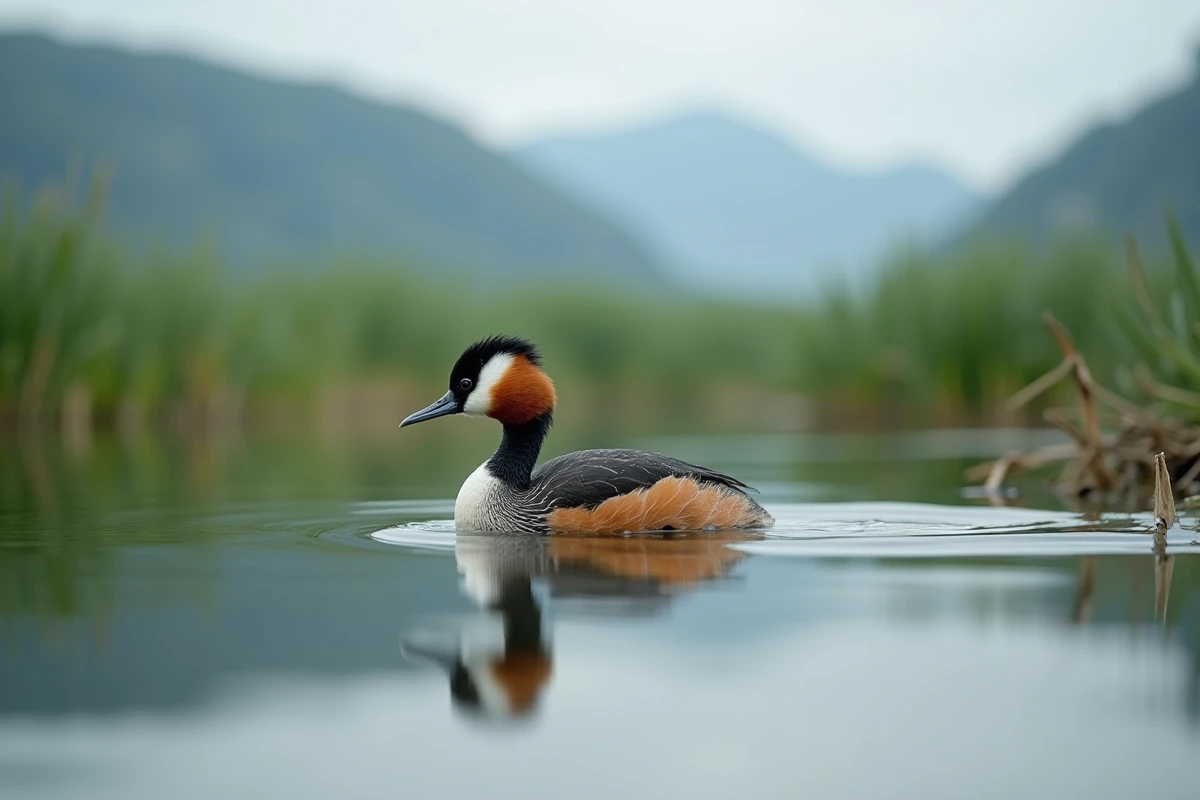
The reserve hosts species identifiable at a reasonable distance: the great crested grebe, recognizable by its silhouette and spectacular courtship display, the grey heron hovering above the reedbeds, or the kingfisher whose sharp call signals its presence even before it is visually spotted.
A standard pair of binoculars is sufficient for most observations from the shores. Recognizing calls remains the most reliable means to detect songbirds hidden in dense vegetation. Several local ornithologist guides incorporate call learning into their outings, making the experience accessible to beginners.
Documented pressures and threats to the avifauna of Lake Aiguebelette
The Natura 2000 report 2012-2024 does not limit itself to good news. It identifies several pressures weighing on the avifauna of the area that any responsible birdwatching outing should take into account.
The coexistence of recreational activities and breeding zones remains the main point of tension. Trampling of the shores during nesting is among the assessed threats. Non-motorized boats, allowed on the lake, also generate occasional disturbances when they approach the reedbeds.
The temporal zoning strategy implemented since 2023 constitutes a direct response to these pressures. It is based on a simple principle: allow access where the impact is low, restrict it where biological stakes are high. This management model, co-managed by the Community of communes of Lake Aiguebelette and the Conservatoire d’espaces naturels de Savoie, makes Aiguebelette an observation area where protection is not just a slogan but an operational system.
Lake Aiguebelette concentrates, within a limited perimeter, a recent regulatory framework, populations of birds in a positive dynamic, and a management system that organizes coexistence between visitors and breeding wildlife. Observing birds here requires accepting the constraints of zoning, but it is precisely this framework that enables quality observations to be possible.