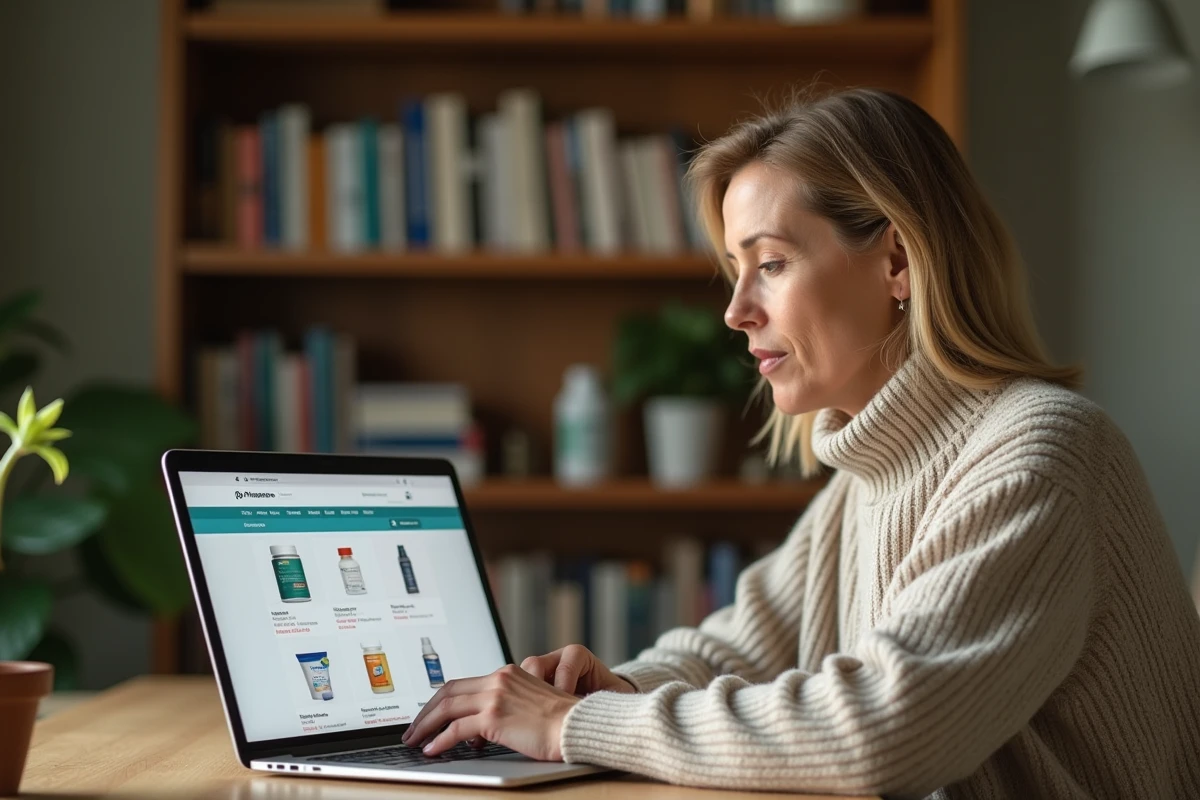
You order a dietary supplement on a Sunday evening, receive a package three days later, and realize that the site displayed neither a pharmacy address nor the pharmacist’s name. This scenario remains common, exposing you to products with no traceability. Choosing your online pharmacy wisely starts with knowing how to read the concrete signals that separate a reliable site from a dubious storefront.
Online Pharmacy: What the Legal Notice Page Reveals
Before looking at the catalog or prices, you open the legal notice page. This is the first filter, and the quickest. An authorized online pharmacy in France must be linked to a physical pharmacy, with a verifiable address.
You look for three specific elements: the name of the licensed pharmacist, the registration number with the Order of Pharmacists, and the authorization issued by the Regional Health Agency (ARS). If any of these three elements are missing, you leave the site. Some platforms display a clickable European logo (the common European logo) that links to the official list of authorized pharmacies. It’s a good reflex to click on it to verify that the link works and points to the national register.
Feedback varies on the ease of access to this information depending on the sites, but a pharmacy that makes its legal notices hard to find already sends a bad signal. For those who want to learn more about Pharmavia, the site displays this information accessibly right from the homepage.

Payment Security and Data Protection on an Online Pharmacy
You proceed to checkout, and this is where the question of security becomes very concrete. Payment on an online pharmacy must go through an encrypted protocol. You check for the presence of a padlock in the address bar and the HTTPS prefix.
Beyond payment, the protection of health data deserves special attention. When purchasing medications or parapharmacy products, you sometimes provide information about your health status. A reputable pharmacy details its privacy policy and does not share this data with commercial third parties.
Points to check before validating a cart:
- The site offers at least two secure payment methods (credit card via a recognized provider, PayPal or equivalent)
- The return and refund policy is clearly displayed, with a withdrawal period compliant with French law
- Personal and health data are not resold, which should be stated in the privacy policy
Online Pharmaceutical Advice: A Criterion Too Often Ignored
People often focus on prices and delivery, but access to a licensed pharmacist changes the quality of service. A reliable online pharmacy provides a chat, a phone number, or a contact form handled by a healthcare professional.
This is not a detail. When you hesitate between two dosages of a dietary supplement, or when you want to check an interaction with an ongoing treatment, being able to ask a pharmacist makes all the difference. Sites that rely solely on an automated FAQ without any human access do not fulfill this function.
Sale of Prescription Medications: What is Allowed
In France, only non-prescription medications can be sold online. Any site that offers prescription medications without requiring a prescription operates outside the legal framework. This is an immediate warning signal.
Parapharmacy products (cosmetics, dietary supplements, Class I medical devices) are not subject to the same restrictions, but they must also come from traceable distribution channels. An abnormally low price on a well-known brand product may indicate parallel sourcing.

Counterfeit Medications on the Internet: Concrete Warning Signals
Since 2023, European health authorities have reported an increase in seizures of counterfeit medications sold online. The most affected categories include treatments for erectile dysfunction, weight loss products, and certain psychotropics. Coordinated operations between the European Anti-Fraud Office (OLAF) and Europol have specifically targeted unauthorized online pharmacies.
This reality requires heightened vigilance. Here are the signals that should raise alarms:
- The site does not ask for any health information before selling a therapeutic product
- The received packaging does not include a lot number, a legible expiration date, or an instruction manual in French
- The site makes promises of guaranteed medical results, which is prohibited by French regulations
- No identifiable pharmacist appears on the site, neither in the legal notices nor in the contact section
Buying medications online is not risky in itself. The risk comes from sites that circumvent the regulatory framework. When you order from a pharmacy linked to a physical pharmacy, registered with the Order and authorized by the ARS, you benefit from the same level of traceability as at the counter.
Comparing Online Pharmacies: Prices, Customer Service, and Delivery Times
Once reliability is verified, you can compare based on practical criteria. The price of parapharmacy products varies significantly from one site to another, sometimes significantly in dermocosmetic ranges or dietary supplements.
Shipping costs often constitute the real differentiator. Some sites offer free shipping from a modest order amount, while others impose high fixed fees. You also look at the announced delivery time and delivery options (pickup point, home delivery, express).
Customer service deserves a simple test: send a question before ordering. The response time and quality give a reliable indication of the pharmacy’s seriousness. A site that responds within a few hours with a personalized answer stands out clearly from a form with no follow-up.
Choosing your online pharmacy relies on concrete checks that take just a few minutes. Legal notices, ARS authorization, access to a pharmacist, payment security: these four criteria are enough to eliminate the vast majority of problematic sites and order your health products with the same confidence as at a pharmacy counter.